Mt to kg Converter and Kg to Tons Converter used in UAE, India and Pakistan as standard Mt weight in Kg
When dealing with large-scale weights in UAE industries—such as shipping, mining, agriculture, and construction—a reliable unit conversion is essential. One of the most widely used tools is the Mt to Kg converter and Kilograms to Mt tool, often referred to as Ton to kg calculator or converter. In addition you can it as Mt to lbs converter.
This tool is vital for converting the Metric ton to Kg and vice versa, this is standard unit converter, used in countriesl UAE, india and Pakistan, where Kg is tandard unit, pound is rarely used. This converter will help you to change form Ton into Kg and Kg into Mt, means works on both ways. By default it works as in other words metric tonnes to kg converter but values for different Ton types may vary.
AQAM TON CONVERTER / محول الطن
Convert MT in Kg and Kilogram to Mt
1 Metric Ton = 1000 Kg
1 Kg = 0.001 Metric Ton
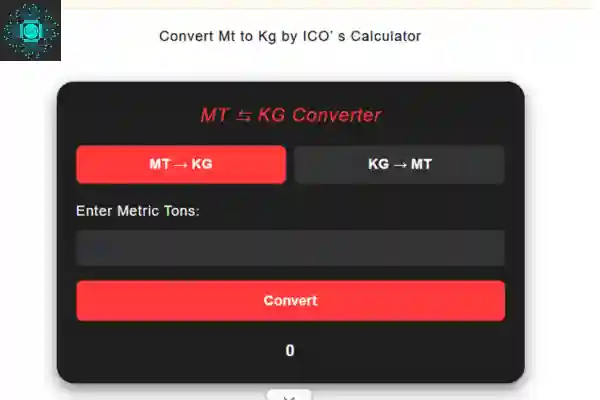
Below is an other Digital MT to Kg Calculatar by ICO, you can use it for conversion as well.
Formula used in Mt to Kg converter Calculator
Formula for Mt to Kg converter
Kilograms = Metric Tons × 1000
Take for granted
5 Metric Tons × 1000 = 5000 Kilograms
So, 5 MT = 5000 kg.
Kilogram to Metric Ton Formula
Metric Tons = Kilograms ÷ 1000
Example
2500 Kilograms ÷ 1000 = 2.5 Metric Tons
So, 2500 kg = 2.5 MT.
Formual for MT to Lbs Converter
lbs = MT × 2204.62
Note: The weight of a “ton” is not the same in all measurement systems. There are three commonly used ton units in the world. If you are converting US Tons or Imperial Tons, the kilogram value will be different.
Which countries convert MT into Kg and which dont use it
The conversion between metric tons and kilograms (kg) comes from the metric system, a measurement system first introduced in France in 1795 to simplify calculations and standardize weights and measures. The system later evolved into the International System of Units (SI) in 1960, which is now used globally in science, trade, and industry.
One of the simplest and most practical relationships in this system is that 1 metric ton equals exactly 1000 kilograms. Because the metric system is based on powers of ten, conversions like metric tonne to kg are straightforward, accurate, and easy to remember.
Before the adoption of the metric system in South Asia, traditional units such as the “ser” (seer) were widely used in regions that later became India and Pakistan. A traditional ser was not equal to 1000 grams; historically it was roughly 933 grams in some regions and about 907 grams in others.
When these countries gradually adopted the metric system during the mid-20th century, the kilogram replaced the ser as the standard unit. However, in many rural markets people still informally refer to a kilogram as a “ser,” even though they now treat it as exactly 1000 grams.
This change made weight calculations far easier, especially for trade and large-scale measurements like metric tons and kilograms. Today, the MT-to-kg system is widely used not only in South Asia but also in countries such as United Arab Emirates, where metric units are standard for commerce, logistics, and industrial measurements.
Other types of Tons that are not equal to Metric ton
Ton and Metric ton difference confusing traders across worldwide
While the metric ton equals 1000 kilograms, international trade sometimes involves other units also called “ton.” This metric ton and ton difference becomes important when dealing with businesses in countries where non-metric ton units are still recognized. If traders, manufacturers, or logistics companies work with partners in the United States or the United Kingdom, they may encounter ton measurements that are not equal to a metric ton.
In the United States, the commonly used unit is the US ton (short ton), which equals approximately 907 kilograms. In the United Kingdom, the traditional unit was the imperial ton (long ton), which equals about 1016 kilograms. Although both countries widely use the metric system in many industries today, these older ton units still appear in some sectors, historical references, and trade documentation.
For businesses involved in international shipping, metal trading, agriculture, or bulk commodities, this difference can significantly affect calculations. For example, a shipment described as “1 ton” could represent 907 kg, 1000 kg, or 1016 kg, depending on the system used. Misinterpreting these values can lead to pricing errors, incorrect cargo weight estimates, or contractual misunderstandings.
For this reason, modern global trade generally prefers the metric ton, as it provides a clear and universally recognized standard of 1000 kilograms.
3 Tons Confusing in measurement of MT TO KG Converter
| Ton Unit | Equivalent in Kilograms (kg) | Notes |
|---|---|---|
| Metric Ton | 1000 kg | Standard unit in the metric system used in Metal scrap industry |
| US Ton | 907.18 kg | Commonly used in American commerce, mining, and shipping |
| British Ton | 1016.05 kg | Traditional British measurement still referenced in maritime and industrial contexts |
To handle these conversions, many industries rely on metric ton to kg converter to ensure data accuracy across systems.
Applications of mt to kg converters
- Shipping and Logistics
Cargo and container loads are often calculated in metric tons but must be converted into kilograms for customs or billing purposes. - Construction
Materials like steel, sand, and cement are measured in tonnes, and their weight must be reported in kilograms for accuracy and invoicing. - Agriculture
Grain and fertilizer quantities are typically reported in metric tons but need to be converted using a metric ton kg converter for inventory tracking. - Mining and Minerals
Resources like coal and ore are measured in tons but analyzed in kilograms in scientific and trade reports. - Environmental Monitoring
Carbon emissions are commonly calculated in metric tons and then converted to kilograms for environmental impact assessments.
Why You Should Use a Metric tons to KG Converter
- Precision: Reduces human error in high-volume data conversion
- Speed: Instant results for large or bulk values
- Global Compatibility: Adheres to international measurement standards
- Convenience: Easily handles conversions between Kilograms to Metric ton and Metric tons to Kilograms.
By using a reliable mt to kgs converter, businesses and professionals can streamline operations and maintain consistency in their data.
Conclusion
In today’s interconnected world, understanding and accurately converting weight units is essential. A mt to kg converter plays a critical role in simplifying this process. Whether you’re a farmer in India, a shipping coordinator in Europe, or a construction manager in the US, this tool ensures accuracy and efficiency in your weight-related calculations.
Stay accurate. Stay global. Use the mt to kg converter to make every ton count.
FAQs Most of you ask us as under
Why is a metric ton exactly 1000 kilograms?The metric system was designed around powers of ten to simplify calculations. Because a kilogram is the base unit of mass, defining a metric ton as 1000 kilograms allows easy scaling for large weights without complex fractions or conversions.
Why do some industries calculate in kilograms even when cargo is measured in metric tons?
Large shipments are usually described in metric tons for convenience, but calculations such as pricing, inventory tracking, or laboratory analysis often require kilograms for greater precision. Converting 1 MT to kg makes detailed calculations easier.
Can MT to KG conversion affect pricing in international commodity trade?
Yes. Many commodities such as steel, scrap metal, grains, and minerals are traded in metric tons, but prices may sometimes be calculated per kilogram. Accurate conversion ensures correct pricing and prevents misunderstandings between buyers and sellers.
Why do freight documents sometimes list both MT and KG?
Shipping and logistics systems often record weight in both metric tons and kilograms to avoid confusion. Metric tons are easier to read for bulk cargo, while kilograms provide exact weight values for customs, invoices, and warehouse records.
Is the MT to KG formula used in scientific measurements like pharmaceutical industries?
Scientists usually work directly in kilograms or grams for precision. However, when reporting very large quantities—such as industrial materials, environmental data, or resource production—results may be expressed in metric tons, which can then be converted to kilograms when needed. In USA pharmaceutical use this unit conversion for making it mostly understandable for many coutries like China and India, the giant markets.
Why do exporters prefer metric tons instead of kilograms for bulk goods?
For extremely large quantities, writing numbers in kilograms becomes impractical. For example, 50 metric tons equals 50,000 kilograms, so exporters often use metric tons for readability while maintaining the exact conversion relationship
Can misunderstanding ton units affect international shipments?
Yes. If a contract simply states “ton” without clarification, it may refer to different ton units used in various countries. To avoid confusion, international shipping agreements usually specify metric ton (1000 kg).
Why is MT commonly used in scrap metal and construction industries?
Industries handling large volumes of heavy materials prefer metric tons because it simplifies weight reporting. However, precise calculations such as inventory records, invoices, or quality analysis often convert those values into kilograms and an other reason is that the mostly in UAE, the people are Asians belonging to China , Nepa, Srilanka and Indonesia who understand this conversion easily.
Do digital weighing systems measure directly in metric tons?
.
Most industrial scales actually measure weight in kilograms and then automatically convert the value into metric tons when displaying large quantities.Why is the conversion MT to KG considered one of the simplest weight conversions?
Because the conversion involves only multiplying or dividing by 1000, it is one of the easiest and most reliable weight conversions within the metric system.
1 Tan kitna hota hai
Ek tan 1000 Kilo ka hota India men